The paradox of modern personalization is getting worse: the better your algorithms become at predicting what users want, the more uncomfortable users feel about using your product.
Microsoft’s Recall feature offers a perfect case study. Announced as a productivity breakthrough that would let users search through everything they’d ever done on their PC, it immediately triggered what one industry observer called “surveillance perception”—the feeling that something is watching you even when you asked it to. Despite giving users granular controls over what gets captured and stored, the damage was done. The feature felt invasive precisely because it worked as designed.
Balancing powerful personalization with user comfort highlights the complexity of translating individual needs and data into insights that feel both helpful and trustworthy.
This isn’t an isolated incident. Even advanced personalization features can fail when users don’t understand how or why recommendations are made, leading to mistrust or rejection of the system. It’s a preview of the collision coming to every product team building AI-powered experiences.
The Control Gap Isn’t Just Widening—It’s Accelerating
Every fake click, every cleared cookie, every time someone uses incognito mode or a different device to avoid your tracking—that’s not just a privacy concern. It’s a direct attack on the data quality your personalization depends on. Providing consistent explanations and experiences across all user interactions is essential to maintain user trust and ensure the integrity of your data.
Why Accuracy Isn’t Enough Anymore
For the past decade, the personalization arms race has been about one metric: accuracy. Can you predict what the user wants? Can you surface it faster than your competitor?
But accuracy without legibility creates the uncanny valley of UX. When your recommendation engine is right but users don’t know why it’s right, you’re not building trust—you’re building unease.
Think about the difference between these two experiences:
Opaque personalization: You open a news app and see an article about a niche topic you researched once, three weeks ago. No explanation. Just an eerily accurate guess sitting at the top of your feed.
Legible personalization: You open the same app and see: “Because you read 3 articles about urban farming last month, we thought you’d like this update on vertical agriculture policy.”
This is an example of an explainable recommendation, where the system provides a human-interpretable justification for its suggestion. Such explanations improve transparency and user trust by clarifying the reasoning behind personalized content.
Same recommendation. Completely different emotional response.
The second version does something crucial: it shows the math. It makes the cause-and-effect relationship visible. By surfacing the relevant attributes and inputs—such as your reading history and interests—used in the recommendation process, it helps users understand the logic behind the suggestion. It gives you information you can act on—if you don’t want urban farming content, you now know what signal to change.
Data Collection and Analysis: The Foundation of Personalization
Personalization starts with data—lots of it. Every click, search, purchase, and review is a signal that, when collected and analyzed, helps businesses understand what their users want. This foundation is what enables companies to deliver relevant content and personalized recommendations that feel intuitive rather than intrusive.
At the heart of this process are user and item IDs. These identifiers allow systems to track interactions and relationships between users and products, services, or content. By mapping these connections, data scientists can uncover patterns that drive collaborative filtering—one of the most effective methods for surfacing recommendations that match a user’s unique preferences. For example, if users with similar item IDs consistently rate certain products highly, the system can suggest those items to others with matching tastes.
But raw data alone isn’t enough. Artificial intelligence, especially models fine-tuned for specific tasks like BERT, can analyze vast amounts of user feedback, ratings, and clickstream data to generate explanations for why a particular recommendation appears. Natural language generation takes this a step further, transforming complex data relationships into clear, human-readable explanations. Instead of a black-box suggestion, users see, “We recommended this because you liked similar items and users with your interests rated it highly.” This clarity is critical for enhancing user trust and making the personalization process feel transparent.
Recent research underscores the value of explainable AI in this context. When users understand the logic behind recommendations—whether through collaborative filtering, content analysis, or other methods—they’re more likely to trust the system and engage authentically. This trust is especially important in high-stakes fields like wealth management and healthcare. For instance, advisors can use explainable AI to show clients how investment recommendations align with their financial goals and risk tolerance, while healthcare professionals can provide patients with clear reasons for personalized treatment plans based on their medical history and lifestyle.
Of course, collecting and analyzing data at scale brings challenges. Firms must balance the drive for more accurate, relevant recommendations with the need to protect user privacy and comply with regulations. Robust data governance, transparent data practices, and clear explanations are essential to mitigate risk and maintain user trust. Metrics like click-through rates, conversion rates, and engagement help product teams evaluate the performance of their personalization strategies and identify areas for improvement.
Ultimately, explainable AI empowers both users and businesses. Users gain control and clarity, understanding not just what is recommended but why. Businesses benefit from more authentic user interactions, higher data quality, and the ability to demonstrate compliance and ethical objectives. As personalization becomes more sophisticated, integrating explainable AI isn’t just a technical upgrade—it’s a critical step toward building lasting relationships and delivering value at every touchpoint.
The Self-Inflicted Performance Spiral
Here’s where this becomes an existential problem for product teams rather than just a UX nicety: when users don’t understand your personalization, they start to distrust it. When they distrust it, they game it. When they game it, your data quality degrades. When your data degrades, your personalization gets worse. When it gets worse, trust falls further.
You enter what we might call a “self-inflicted performance spiral”—a vicious cycle where opacity breeds defensive user behavior, which undermines the very systems meant to serve them. Black-box recommender models often struggle with transparency and user trust, as their opaque decision-making processes make it difficult for users to understand or accept recommendations.
Microsoft Recall illustrates this perfectly. Even with comprehensive user controls, the feature’s lack of upfront legibility about why it was capturing specific moments led to immediate pushback. Users couldn’t see the logic, so they assumed the worst. Some disabled it entirely. Others modified their behavior to avoid triggering it. The result? A feature designed to make computing more helpful instead made users more guarded.
The cruel irony: the more sophisticated your personalization becomes, the more critical explainability becomes to prevent this spiral. The desired outcome is improved trust and engagement, as users are more likely to interact positively with systems they understand. Explainable personalization can enhance user trust by providing transparent, comprehensible recommendations and clear explanations for system decisions.
What ‘Showing Your Math’ Actually Means
Explainable personalization isn’t about dumping technical details on users. It’s about making three things visible:
1. The input signal: What action or data point triggered this personalization?
“You watched 4 videos about sourdough starters this week” is an input signal.
2. The logic: How did we get from input to output?
“People who watch baking content also tend to enjoy cooking equipment reviews” is logic.
3. The control mechanism: How can I change this if I want different results?
“Remove this from your history” or “Not interested in baking content” is a control mechanism.
In modern personalization systems, generating explanations is treated as a dedicated generation task. Teams use evaluation and experiment to refine how explanations are produced, ensuring that the justifications provided are both accurate and understandable to users. This process involves testing different strategies for generating explanations and measuring their effectiveness to improve overall recommendation quality.
Together, these three elements transform personalization from magic (which feels like surveillance) into mechanics (which feels like service).
The Competitive Advantage of Legibility
As ambient AI features become standard—from OS-level activity tracking to continuous voice assistants to augmented reality overlays—every company will face the same trust challenge Microsoft hit with Recall.
The winners won’t necessarily be the ones with the most accurate predictions. They’ll be the ones who make their predictions most understandable.
Consider the advantage: while your competitors are optimizing for fractions of a percentage point in recommendation accuracy, you could be building something more durable—a user base that understands how your system works and therefore trusts it enough to use it authentically. By integrating advanced technology and tools, such as Transformer-based architectures and explainable recommendation models, you can enhance the efficiency and effectiveness of explainable personalization. These approaches not only improve system performance but also enhance user trust by making recommendations more transparent and understandable.
Authentic usage means better data. Better data means better personalization. Better personalization with clear explanations means more trust. More trust means more authentic usage.
That’s not a vicious cycle. That’s a flywheel.
Making the Shift
For teams currently treating explainability as a compliance checkbox or an accessibility feature, here’s the reframe: explainability is now a core product differentiator. While basic automation can deliver standardized experiences, explainable, personalized automation goes further by building trust and transparency, setting your solution apart from the competition.
The fastest way to stop “creepy” UX isn’t to personalize less. It’s to explain more. Show users the input signals you’re using. Make your logic visible. Give them meaningful controls that actually change the output. Isolating business logic from code—such as through decision tables—enables more transparent and agile personalization, allowing business stakeholders to encode intent directly into workflows.
Because the alternative—increasingly sophisticated black-box systems meeting increasingly defensive user behavior—ends with everyone losing. You get worse data. Users get worse experiences. The gap between what AI can do and what users will let it do keeps widening. Explainable personalization empowers advisors in wealth management by enabling them to deliver more personalized, scalable advice that deepens client relationships. Enabling trust and operational efficiency through explainable systems is a key benefit for both users and organizations.
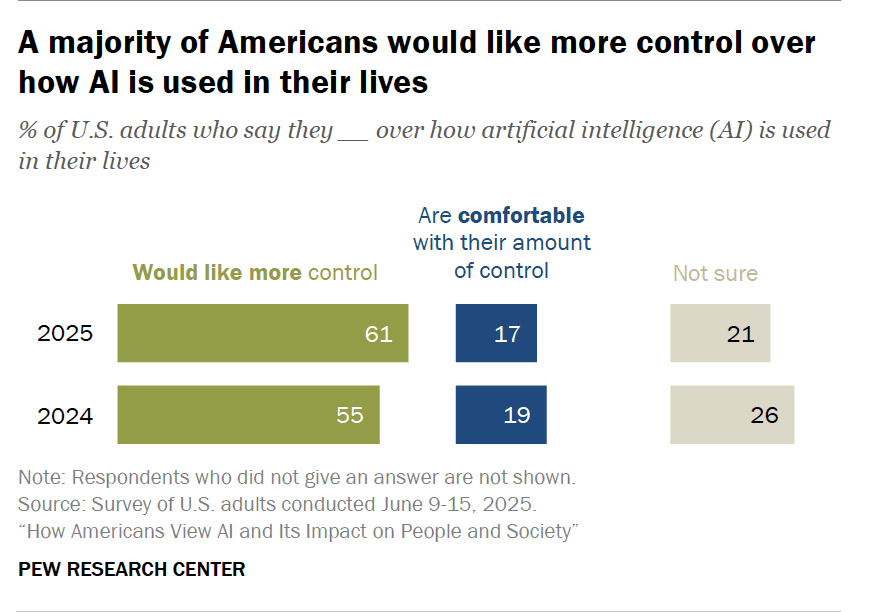
With 61% of Americans already demanding more control over AI in their lives—and that number growing year over year—the window for voluntary adoption of explainable design is closing. Soon it won’t be a competitive advantage. It will be table stakes for staying in the game. Note: Making explainable personalization a best practice ensures your approach reflects each user’s unique goals and preferences, rather than generic assumptions.
The companies that crack explainable personalization won’t just avoid the “creepy” label. They’ll earn something far more valuable: permission to actually use the capabilities they’ve built. For example, using fine-tuned BERT models that leverage user ID and user–item features allows the model to generate personalized, diverse explanations that resonate with individual users.
And in an era where a clear majority of users want control they don’t currently have, permission might be the most important competitive advantage you can develop.